PP Polypropylene
1. Material Introduction
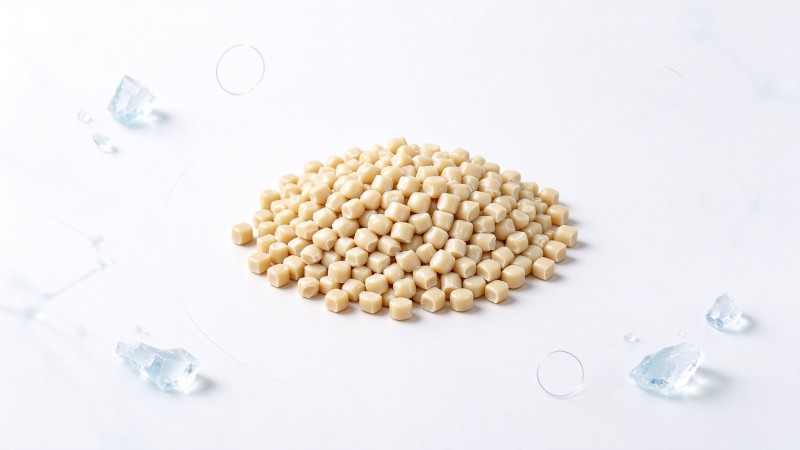
PP stands for Polypropylene. It is polymerized from propylene monomers with catalyst, chemical formula \(\boldsymbol{(C_3H_6)_n}\). It appears as white waxy translucent pellets with density of 0.89~0.91 g/cm³, the lightest among five general-purpose plastics.
Global annual output exceeds 80 million metric tons, ranking 2nd only after PE.
According to molecular structure, it is divided into 3 grades:
- - Homopolymer PP (PP-H): high rigidity
- - Block copolymer PP (PP-B): good impact resistance
- - Random copolymer PP (PP-R): high transparency
It is widely used in food packaging, automotive components, building pipes and woven bags.
| Chemical Formula | CAS No. | Molecular Weight Range | Polymerization Method | Resin Morphology |
|---|---|---|---|---|
| (C3H6)n | 9003-07-0 | 100,000 ~ 700,000 | Coordination Polymerization | White waxy granules |
2. Specifications & Grades
| Product Form | Common Specifications / Grades | Features |
|---|---|---|
| Homopolymer PP (PP-H) | T30S, L5E89, PPH-T03, etc. | High rigidity, high hardness, good temperature resistance, for fiber drawing and injection molding |
| Block Copolymer PP (PP-B) | K8003, K8303, K9829H, etc. | Excellent impact resistance, good low-temperature toughness, for automotive and home appliance parts |
| Random Copolymer PP (PP-R) | RP210G, B4902, M800E, etc. | High transparency, good gloss, for food containers and transparent packaging |
| PP-R Pipe | S4/S3.2/S2.5 series, dn20~dn160 | For cold and hot water, pressure bearing 1.0~2.0MPa, service life 50 years |
| BOPP Film | Thickness 12~60 μm | Biaxially oriented, high strength, good transparency, main packaging film |
3. Chemical Composition & Properties
Reference Standard: GB/T 12670-2008 Polypropylene (PP) Resin
Chemical Composition
| Component | Content (phr) | Component | Content (phr) |
|---|---|---|---|
| PP Resin | 100 | Antioxidant | 0.1~0.5 |
| Nucleating Agent | 0~0.3 | Lubricant | 0.1~0.5 |
| Filler (Talc Powder) | 0~40 | Colorant | 0~2 |
| Toughener (POE) | 0~20 | UV Stabilizer | 0~0.5 |
Physical & Mechanical Properties
| Property Index | Value | Unit | Property Index | Value | Unit |
|---|---|---|---|---|---|
| Density | 0.89~0.91 | g/cm³ | Tensile Strength | 21~40 | MPa |
| Melting Point | 164~170 | ℃ | Flexural Modulus | 800~1800 | MPa |
| Heat Distortion Temperature | 80~120 | ℃ | Notched Impact Strength | 2~15 | kJ/m² |
| Melt Flow Rate | 0.3~60 | g/10min | Elongation at Break | 200~450 | % |
| Water Absorption | <0.01 | % | Volume Resistivity | >10¹⁶ | Ω·cm |
4. Functions & Applications
Key Advantages
- - Density is only 0.89~0.91 g/cm³, lighter than water. For parts of equal volume, PP is over 35% lighter than PVC and over 25% lighter than ABS. It is adopted for automotive bumpers and instrument panels to reduce vehicle weight and carbon emission.
- - Resistant to acid, alkali and salt solution. Its performance remains stable below 80℃. It is widely used in chemical storage tanks, pickling tanks and waste gas treatment towers, with chemical stability comparable to PE.
- - Melting point 164~170℃, continuous service temperature 110~120℃, more than 20℃ higher than PE. Suitable for microwave food containers and steam-sterilizable medical devices.
- - Different grades can be produced by adjusting ethylene content and polymerization process: homopolymer PP with high rigidity for pipes; block copolymer PP with good toughness for bumpers; random copolymer PP with high transparency for food containers. Its performance is highly tunable via formulation.
- - Water absorption less than 0.01%, nearly non-hygroscopic. It maintains stable dimension in humid environment, and its electrical insulation performance is not affected by humidity, ideal for electronic housings and washing machine inner drums.
- - The price of general injection grade PP is about 8000~9500 CNY/ton, over 30% cheaper than ABS and over 60% cheaper than PC. The cost advantage supports its large-scale application.
Limitations
Homopolymer PP suffers from low-temperature brittleness. Its impact strength drops sharply below 0℃ and may crack under -20℃. Cold-resistant modified copolymer PP shall be selected for outdoor structural parts used in winter. Its weather resistance is ordinary; long-term UV exposure causes aging and embrittlement. Antioxidants and UV stabilizers are required for long-term outdoor use. PP is combustible with limiting oxygen index of approx. 17%, much lower than PVC. Flame retardant additives or alternative materials are required for applications with strict flame retardant requirements.
5. Application Fields
| Application Industry | Typical Products / Scenarios |
|---|---|
| Packaging Industry (38%) | Food fresh-keeping boxes, beverage bottles, woven bags, BOPP films, turnover boxes |
| Automotive Industry (22%) | Bumpers, instrument panels, door panels, interior parts, battery housings |
| Daily Injection Molding (19%) | Plastic chairs, storage boxes, toys, clothes hangers, non-woven fabrics |
| Medical Devices | Syringes, infusion bottles, petri dishes, medical trays, centrifuge tubes |
| Chemical Equipment | Pickling tanks, storage tanks, pipelines, waste gas treatment towers, electroplating fixtures |
| Building HVAC | PP-R water supply pipes, PP air ducts, anti-corrosion fans, laboratory countertops |
| Electrical & Electronics | Washing machine inner tubs, air conditioner housings, refrigerator drawers, insulating partitions |
6. Market Price
Data Period: April-August 2026 | Source: Ex-factory prices of major domestic PP resin manufacturers plus market quotations from East China and North China
| Product Form | Specification | Reference Price | Unit |
|---|---|---|---|
| General Injection Molding PP | Homopolymer Premium Grade | 8,000~9,500 | CNY/ton |
| Fiber Grade PP | PPH-T03 Fiber Grade | 8.8~9.5 | CNY/kg |
| High Impact Copolymer PP | K9829H Automotive Grade | 8,900~9,100 | CNY/ton |
| High Transparent Random Copolymer PP | Food Grade | 10~12 | CNY/kg |
| PP-R Water Supply Pipe | S4 dn20 | 3~5 | CNY/m |
Note:
PP prices are greatly affected by fluctuations in crude oil and propylene monomer markets. Food grade and medical grade command a premium of 10%-30%. White or colored modified materials are priced with an additional 500-2000 CNY/ton depending on formulations. Recycled materials are 20%-40% cheaper with obvious deterioration in performance.
7. Major Brands
| Brand | Type | Core Advantages |
|---|---|---|
| Sinopec (Yanshan/Maoming) | Domestic | China's largest PP manufacturer, annual capacity over 10 million tons with full grade coverage |
| PetroChina | Domestic | Major production bases in Northwest and Northeast China, high market share in fiber and film grades |
| Lotte Chemical (South Korea) | International | High-flow grades such as SJ170M enjoy good reputation in home appliance and automotive industries |
| LyondellBasell | International | One of the world's largest PP producers with complete food and medical grade portfolio |
| Saudi Basic Industries Corporation (SABIC) | International | Largest petrochemical enterprise in the Middle East, large export volume of general-purpose PP with competitive pricing |
8. Selection Guide
Identification Methods
1. Combustion test: PP burns with blue flame, releases paraffin odor, melts and drips, and continues burning after leaving fire.
2. Density test: PP density is 0.89~0.91. It floats in clean water and is the lightest among general-purpose plastics.
3. Marking check: Qualified PP products are printed with brand, specification, standard number (GB/T 12670) and production date.
Tips to Avoid Pitfalls
1. Beware of recycled or filled materials being disguised as virgin resin. Do not purchase pellets with grey color, impurities or pungent odor.
2. PP for food contact must comply with GB 4806.7 and be accompanied by third-party test reports.
3. Ordinary homopolymer PP cannot be used under low-temperature conditions due to insufficient impact strength. Copolymer PP or cold-resistant modified materials are required.
9. Storage, Transportation & Safety
1. Resin pellets shall be stored in cool and dry places away from direct sunlight, with storage period no more than 12 months.
2. Ambient temperature ≤40℃, relative humidity<80%. Replace damaged packages promptly.
3. PP products shall be kept away from strong oxidants, halogenated compounds and aromatic hydrocarbons, as certain solvents may cause swelling.
4. Waste PP can be recycled and re-pelletized, marked with recycling code "05-PP".
10. Main Industry Standards
| Standard No. | Standard Name |
|---|---|
| GB/T 12670-2008 | Polypropylene (PP) Resin |
| GB/T 2546.1-2006 | Plastics — Polypropylene (PP) moulding and extrusion materials — Part 1: Designation system and basis for classification |
| GB/T 3682-2000 | Plastics — Determination of melt mass-flow rate of thermoplastics |
| GB 4806.7-2016 | Plastic materials and products for food contact |
| GB/T 18742.2-2017 | Polypropylene piping systems for hot and cold water — Part 2: Pipes |
| ISO 1873-1 | Plastics — Polypropylene (PP) moulding and extrusion materials — Designation system |
Disclaimer
This article is sourced from other media and does not represent the views or positions of this website.